Nigeria’s Education System Is Collapsing in Slow Motion and We Keep Acting Surprised
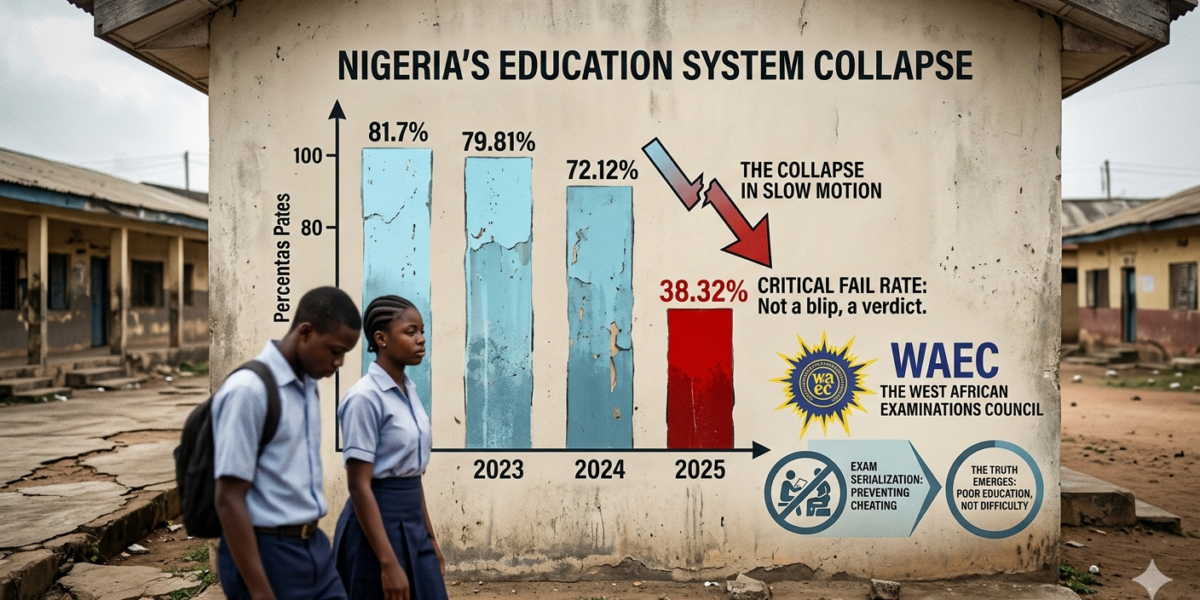
In 2025, only 38.32% of Nigerian students who sat the WAEC examination passed with credits in five subjects including English and Mathematics. That is not a rounding error. That is not a bad year. That is nearly two in every three Nigerian secondary school students failing to meet the basic requirement for university admission. And Nigeria looked at that number, said “hmm,” and moved on.
Let us put that in context. In 2021, the pass rate was 81.7%. In 2023 it was 79.81%. In 2024 it dropped to 72.12%. And in 2025 it fell off a cliff to 38.32% — the worst performance in over a decade. The trajectory is not a blip. It is a collapse in slow motion, and we have been watching it happen in real time.
WAEC’s explanation was that they serialised the objective questions to prevent cheating — meaning they made it harder to copy from the person next to you. And that single change caused the pass rate to drop by 33.8 percentage points. Read that again. The difference between 72% passing and 38% passing was essentially removing the ability to copy in the exam hall. What that tells us is not that WAEC cheated the students. It tells us that the education these students received did not actually teach them what they needed to know. The exam was just where the truth came out.
Nigeria spends 7.08% of its budget on education. UNESCO recommends 15-20% as a minimum for meaningful investment. We have never met that benchmark — not once in our independent history. Between 1960 and 2023, the average was 5.94%. And then we are shocked — genuinely, repeatedly shocked — when the results reflect underinvestment.
The problem is not the students. The students are sitting in overcrowded classrooms with outdated textbooks, being taught by underpaid teachers who are themselves products of an underfunded system. The problem is not even the teachers. The problem is a government that has consistently treated education as a budget line to be managed rather than a national emergency to be solved.
What makes this particularly painful is the two-tier reality it creates. The children of people who can afford private schools — international curriculum, smaller class sizes, functional laboratories — will be fine. They always are. It is the child in the public school in Borno, in Kebbi, in Oyo who absorbs the consequences of every missed allocation, every ASUU strike, every school that has not seen a new textbook since 2009.
Nigeria’s greatest export right now is its educated young people. They leave. They do well abroad. We celebrate them. And we keep underfunding the system that is supposed to produce the next generation of them, wondering why the pipeline is drying up. The 2025 WAEC results are not a wake-up call. We have had those. They are a verdict.