You Left Your Family House to Pay ₦2,500,000 Rent. We Need to Talk About Your Life Choices.
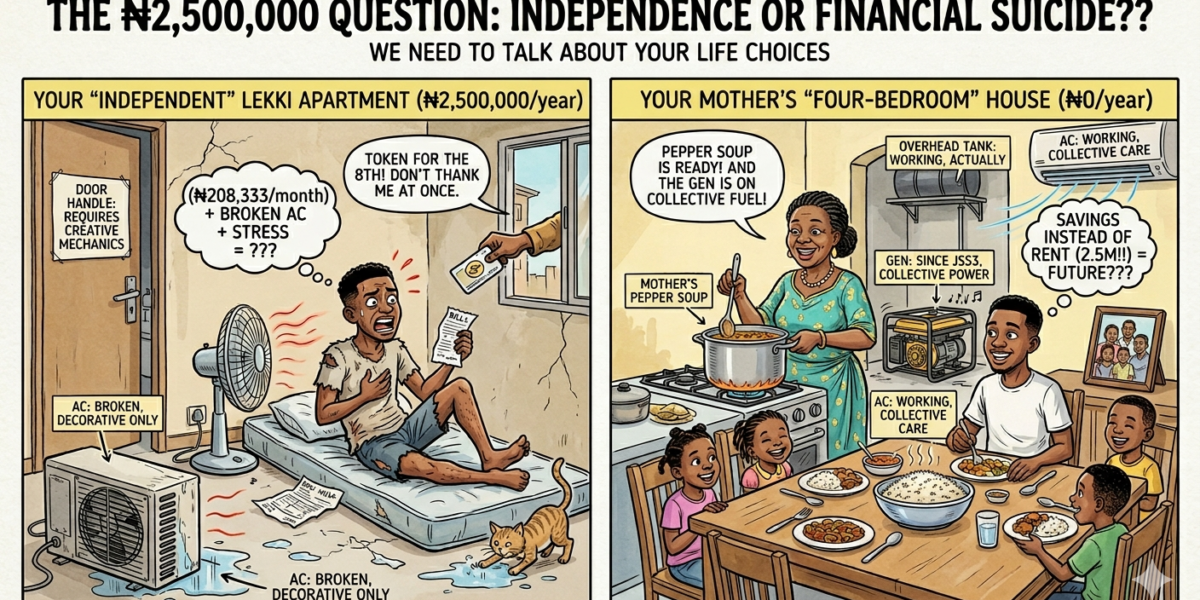
Let us have an honest conversation about the greatest financial self-sabotage in the history of Nigerian adulthood — the voluntary departure from the family house. You packed your bags. You moved to a one-bedroom apartment in Lekki Phase 1 with a broken AC and a landlord who deposits the electricity token on the 8th of every month if he feels like it. And you are paying ₦350,000 a year for this privilege. Meanwhile, your mother’s four-bedroom house — with working overhead tank, actual light fittings, and a generator that was bought when you were in JSS3 — sits thirty minutes away, mostly empty. Explain.
The logic people give for leaving the family house falls into approximately three categories. The first is “I need my independence.” Independence from what, exactly? From free accommodation? From the woman who has fed you for twenty-five years and asks only that you come home before midnight and bring yoghurt sometimes? That independence is costing you ₦29,166 per month minimum. Is it worth it? Be honest.
The second reason is “I can’t bring people to my parents’ house.” People. We know what “people” means. And we are not here to judge — except we are, a little. Because you have constructed an entire parallel financial life around the logistics of your romantic situation, and that is genuinely impressive in a way that deserves acknowledgement. You are essentially paying a monthly subscription fee for privacy. At ₦2,500,000 a year, that is the most expensive situationship in Nigeria.
The third reason is “it’s too far.” Too far from where? Your office in Victoria Island that you can work from home three days a week? The mainland house that has NEPA light more regularly than your Lekki apartment because it is actually close to a substation? Lagos traffic is an equal opportunity tormentor — it does not spare you because your apartment is on the island. Your commute from Surulere takes the same amount of time as everyone else’s commute from Surulere.
Now let us look at what staying in the family house actually gives you. The rent money — let us call it ₦3,500,000 a year when you factor in agency fees and agreement fees — goes directly into savings or investments instead. Over five years, at even modest returns, that is a meaningful amount of money. The food situation is usually better because somebody’s mother is cooking actual food rather than the rice-and-stew-from-three-days-ago situation that is the reality of the solo Lagos apartment. The generator runs on collective contributions instead of your individual pocket. The WiFi is shared. The cleaning lady is shared. Economies of scale, as they say in the economics classes nobody paid attention to.
There is also the family cohesion argument, which sounds soft until you realise how many Nigerian family relationships are maintained almost entirely by proximity. Siblings who live in the same house know each other as adults. They have actual relationships. Siblings who left the family house at 25 see each other at Christmas and funerals and spend the rest of the year as strangers who share a WhatsApp group. The family house is not just accommodation — it is the infrastructure of the relationship.
None of this means you should never leave. There are real reasons to get your own place — marriage, genuine distance, a specific life situation that makes it necessary. But the reflexive departure, the “I’m 26 and I need to move out” move that Nigerians have absorbed from American sitcoms where people live in massive apartments on a barista’s salary — that one deserves scrutiny.
Your mother’s house has hot water, a freezer that works, and someone who will make you pepper soup if you are sick. Your apartment has a broken handle on the bathroom door and a landlord who answers your calls on the third attempt. Make it make sense.